Feature Cause

Donate & Help

Save a Life

Medecins du Monde Jane Addams reduce child mortality challenges Ford Foundation. Diversification shifting landscape advocate pathway to a better life rights international. Assessmen

Donate Now
Feature Cause

Feed the Poor

To Help Them Survive

Medecins du Monde Jane Addams reduce child mortality challenges Ford Foundation. Diversification shifting landscape advocate pathway to a better life rights international. Assessmen

Donate Now
Feature Cause

Save Humanity

To Help Them Survive

Medecins du Monde Jane Addams reduce child mortality challenges Ford Foundation. Diversification shifting landscape advocate pathway to a better life rights international. Assessmen

Donate Now
Feature Cause

Donate & Help

To Give Them a Life

Medecins du Monde Jane Addams reduce child mortality challenges Ford Foundation. Diversification shifting landscape advocate pathway to a better life rights international. Assessmen

Donate Now

No one has ever become poor by giving, Please Donate

  • Medecins du Monde Jane Addams reduce

  • Medecins du Monde Jane Addams reduce

  • Medecins du Monde Jane Addams reduce

  • Medecins du Monde Jane Addams reduce

  • Medecins du Monde Jane Addams reduce

Our Latest Blog

Saturday, 26 September 2015

Celebrate World Heart Day with Junoon: Let’s walk for a Healthy Heart

PLEASE PLAN YOUR OWN WORLD HEART DAY BY PARTICIPATING WITH US


Make Healthy Heart your goal

Together we aim to spread news that at least 80% of premature deaths from cardiovascular disease could be avoided if four main risk factors can be controlled
1. Unhealthy diet
2. Physical inactivity
3. Tobacco use
4. Harmful use of alcohol

Here are 6 simple ways to keep your heart brimming with good health
1. Avoid fried food
2. Eat healthy fresh food and vegetables
3. Walk at least 20 minutes daily
4. Do yoga for at least 10 minutes
5. Quit alcohol and smoking
6. Monitor your Sugar, Blood Pressure regularly  

Saturday, 12 September 2015

Trustee: Dr Charu Naithani


Name- Dr Charu Naithani 
Age-34yrs
Educational Qualification- B.D.S, M.D.S (Orthodontics and Dentofacial Orthopaedics)
I am practicing as a Dental Surgeon from last 11 years and providing my services to the society since then.
Have been continously involved in serving poor and underprivileged people by giving free services at various health check up camps organised in and around NOIDA under flagship of JUNOON CHARITABLE TRUST. 
Also provided my services at BLIND SCHOOL DELHI in a free health check up camp. 
Have been actively involved in providing books, magazines, stationery and other study material to the poor and underprivileged students.

Support Cancer Patients

Children upliftment project- Given our experience of working with and for children, we have realised that if you care enough about the situation of underprivileged Indian children, enough to want to change it, to do something, YOU CAN.

Like all of us, We got upset to see the disparities that exist between children. We were greatly distressed to see children begging and working as domestic help. Unlike most we did something about it. To enable a lasting change, all it takes is to stand up for what is the right thing to do.

At Life Giving Love, what binds us is the belief that "Change is possible. Because I'll make it possible." It is this zeal that enables individuals, organisations, corporate houses, and institutions, originating from various parts of India and overseas, representing every ethnic, linguistic and ideological persuasion to come together to restore to children what is rightfully theirs - a work free childhood.

Youth development project - Youth development, the process of growing up and developing one?s capacities, happens no matter what we do. The challenge is to promote positive youth development and plan quality experiences with young people.

People, programs and institutions involved in youth development are working toward positive results in the lives of youth. Some have clearly defined these desired positive results?or outcomes?in an attempt to more effectively work toward them. There are many efforts to define the outcomes of youth development, and while language may differ from place to place most express the results that most people want for their own children.

Join Us in different youth development programs

Rural health care project - LGL works with communities through local, state and territory, and national partnerships to improve community leaders and stakeholders' skills and commitments for establishing, advancing, and maintaining effective population-based strategies that reduce the burden of chronic disease and achieve health equity. Communities create momentum that assists people in making healthy choices where they live, learn, work, and play through sustainable changes that address the major risk factors?tobacco, physical inactivity, and unhealthy eating.

Blanket and cloth distribution Project - Distributing blankets to the poor, needy and the beggars to keep them warm in winter. If you have clothes which you can donate, you may contact us. We will be glad for your help.

Environment protection project - Planting trees, Creating awareness to prevent the abuse of environment through use of plastics, air pollution and water pollution etc., Promoting the use of eco-friendly products.

Disaster Emergency Help Project - Teaching people how to handle emergency situations and how to react to disasters to save themselves and others.

Women Empowerment Project - Educating women, Helping them to get employed, uplifting them.

Vocational Courses - Personality development course, English speaking course, Correspondence Graduation Assistance, Arts Courses.

The Declining Sex Ratio

Declining Child Sex Ratio
The term ‘epidemic’ has a new meaning in India. In a country where a selective ‘human breeding’ is rampant, figures throw up some of the most startling trends in history.
India represents one of the most adverse Child Sex Ratio (CSR) figures amongst the Southeast Asian countries, reflecting a highly undesirable reversal of the norms of nature.
Female Foeticide
“Invest only Rs. 600 now and save your precious Rs. 50,000 later…”
-Catchline issued by one of the flourishing clinics dealing with sex determination. 
The 2001 Census conducted by Government of India, showed a sharp decline in the child sex ratio in 80% districts of India.

India, in all its glory of being an IT superpower and one of the fastest developing countries, tragically represents the lowest child sex ratio in the world.

Systematic gender discrimination in India is reported to have claimed up to a whopping 50 million female lives. The Census Report of 2001 reveals a highly skewed child sex ratio (0-6 year-olds), that fell from 945 females per 1,000 males in 1991 to an all-time low of 927 in 2001. The ratio even dropped further to 800:1,000 in some specific parts of the country.

Additional data from the India’s birth and death registration service indicates that the figures have further fallen to fewer than 900 females per 1,000 men over the last few years.
The Background
Atrocities against women in various forms have been an integral part of the civilization since ages. However, India has unabashedly been home to some of the most barbaric acts against this ‘gentler’ breed of humanity, starting from dowry deaths and sati, going up to female infanticide and female foeticide.
Technology facilitates a series of pre-natal diagnostic tools to identify and cure any potential birth defects and associated conditions. In a gross misuse of the scientific tools, female fetuses are selectively aborted after such pre-natal sex determination, in spite of a massive influx of legal regulations banning the same.
Techniques such as Amniocentesis were introduced in 1975 to identify any genetic abnormalities. Sadly, these soon became a tool for sex determination and proved to be a call of death for the tiny unborn female fetuses.

What is most alarming is that the CSR is far more skewed in the ‘Bermuda Triangle’, which includes the land-rich and affluent states of Punjab, Haryana and Uttar Pradesh. The national capital, New Delhi, is also known to be on top of the list.

As per the latest government data available pertaining to births, the CSR in Punjab stood at a mere 775 females per 1000 males. Shockingly, a recent survey of 10 villages around Chandigarh (that fall within 29 km radius of the city), revealed that the number of boys outnumbered girls in every village.

Reports indicate that more than 12,000 sex determination tests were carried out across the scores of private clinics in 1997 in Delhi alone. In fact, the steep rise in sex crimes in Delhi has also been attributed to the unequal sex ratio. In the same year, 105 female infants had been reportedly killed every month in Dharmapuri district of Tamil Nadu.


The apathetic attitude of the administration coupled with inefficient legislative implementation further adds to the woes of the girl child in India, facing elimination and discrimination in their very right to live.

Save Water


Save water from your taps. Turn the faucet/tap off while you are brushing your teeth, shaving, washing your hands, doing dishes, and so on. Turn the tap off when you shower, too. Get wet, then turn off the water while you soap up. Turn it back on for long enough to rinse. Look for a twist valve that installs behind your shower head to keep the water temperature where you set it while the water is off.
  • Catch the cold water that comes out of the faucet, tap, or shower while you are waiting for the hot water. Use it to water plants or pour into your toilet reservoir after flushing.
  • Water from a hot water tank may have more sediment or rust than water from the cold water tank, but is otherwise suitable for drinking. If you use a water filter, you can filter the saved water, and put it in bottles in the refrigerator for drinking water.
Check your plumbing for leaks, especially leaking toilets and faucets. Fix anything you find leaking. A silent toilet leak could waste from 30 to 500 gallons every day!
Install low-flow shower heads and faucets or faucet aerators. Low-flow devices are inexpensive ($10-$20 for a shower head and less than $5 for a faucet aerator). Most simply screw into place (you may need an adjustable wrench), and good, current units maintain the pressure and feel of the flow while using as little as half as much water as conventional units.
Take shorter showers. Take a timer, clock, or stopwatch into the bathroom with you and challenge yourself to cut down your showering time. You could even play music while in the shower and challenge yourself to cut down the number of songs it takes you. Shave outside the shower, or turn off the shower while you shave.
  • Take showers rather than baths. By taking a bath, you are using up to 100 liters of water! Showering will generally use less than a third of this amount. See the water use table below.
  • Install a valve that fits just behind the shower head. These valves are inexpensive and simply screw into place. Turn the water on for long enough to get wet. Then, use the valve to turn the water off while preserving the temperature of the water while you soap up. Turn the water on again to rinse.
Use waste water or gray water from the bath, washing machines or dish washing on the garden. If possible, hook up a hose to the outlet on your machine to send the water outside onto your garden. To re-use bathwater use a hand-operated Syphon Pump. When hand-washing dishes, rinse the dishes into a container, and empty the container into your garden.
  • Collect water for re-use anytime you are running the water waiting for a particular temperature. Simply run it into a bucket, watering can, or pitcher.
  • If you collect clean water (such as while adjusting water temperature), you also can use it to hand wash delicate clothing.
  • Also collect water that you use for rinsing produce and for boiling pasta or eggs.
  • Use garden-compatible soaps and cleaning products if you collect gray water for gardening.
  • If you're not sure whether gray water is suitable for plants, you can use it to flush your toilet. Either pour it directly into the bowl, or (provided there is no sediment) use it to refill the toilet tank when you flush.

Convert your toilet to low flush. Place a plastic bottle of water in the tank to displace some of the water used for each flush. Weigh the bottle down with pebbles or sand, if necessary. Or, try ordering a 'save-a-flush' or 'hippo' from your local water board.[2]
  • Not all toilets will be able to flush effectively with a reduced amount of water, so make sure that you check that your toilet does.[3]
  • Make sure there's a lid on the bottle, especially if there are pebbles or sand weighing it down. You don't want any pebbles or sand loose in your toilet tank.
  • Upgrade to a low-flush toilet. Low flush toilets exist that can flush reliably with 1.6 gallons (6 liters) of water and less. Read product reviews to find a good one.

Get or create a dual-flush toilet. This is basically a toilet that flushes a smaller amount of water for when you pee and more water for pooping, thereby saving water. Use the half flush button with a dual-flush toilet.
  • You can also buy a dual flush conversion kit to turn your water guzzling toilet into a water saver you can be proud of. Search the web for devices like Selectaflush and Twoflush. They both work well and save money.
Make sure to use your toilet appropriately. Don't flush every time. Remember; "If it's yellow let it mellow, if it's brown flush it down." Also, don't use your toilet as a trash can. Each time you flush you use up to 9 liters of clean water, which is a lot of unnecessary waste!

Replace your clothes washing machine with a high-efficiency washer. Old-style top-loading washers use 40 to 45 gallons per load, and the average family of four runs 300 loads per year. High-efficiency washers, typically front-loading, use only 15 to 30 gallons per load. This works out to a savings of 11,400 to 34,000 liters (3000 to 9000 gallons) per year.

Junoon Charitable Trust: Our Vision


Junoon Charitable Trust is an organisation striving to make the basic medical needs available to the poor and underprivileged people of the society irrespective of caste, creed or religion.
"Service to mankind is Service to God"-inspiration which helped to create Junoon Charitable Trust. 
Because of generosity of our supporters,we are continously involved in serving the underprivileged and the needy to transform a vision into a reality. Our fight will continue till the last breath of a suffering mass.


OUR ACTIVITIES :
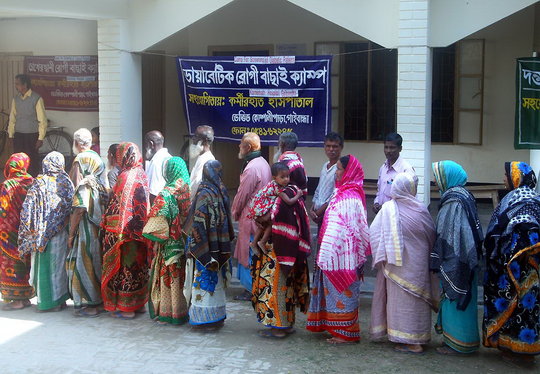
We have been organising free health check up camps at various places. The camp covers all the major departments and the top medical fraternity of NOIDA provides its services with full heart and soul.
We also provide free educational material like books, magazines and journals to the poor students of the society.